 Feb 27,2026
 By: Shivani
Overview
There's a moment — and trust me, you'll know it when it happens — where you round a corner somewhere in Istanbul's Sultanahmet district and just… stop. Your feet stop. Your thoughts stop. Everything stops. Because there it is. The Blue Mosque. Rising out of the haze of a Turkish afternoon like something your brain refuses to fully process. Six minarets. Six! I'd read about it a hundred times, seen the photos, watched the travel vlogs. None of it prepared me.
I've been traveling for over a decade now — budget backpacking through Southeast Asia, splurging on overwater bungalows in the Maldives, sleeping in airport lounges more times than I'd like to admit. But Istanbul? Istanbul did something different to me. And the Blue Mosque sat right at the center of that feeling.
What Actually Is the Blue Mosque — And Why Should You Care?
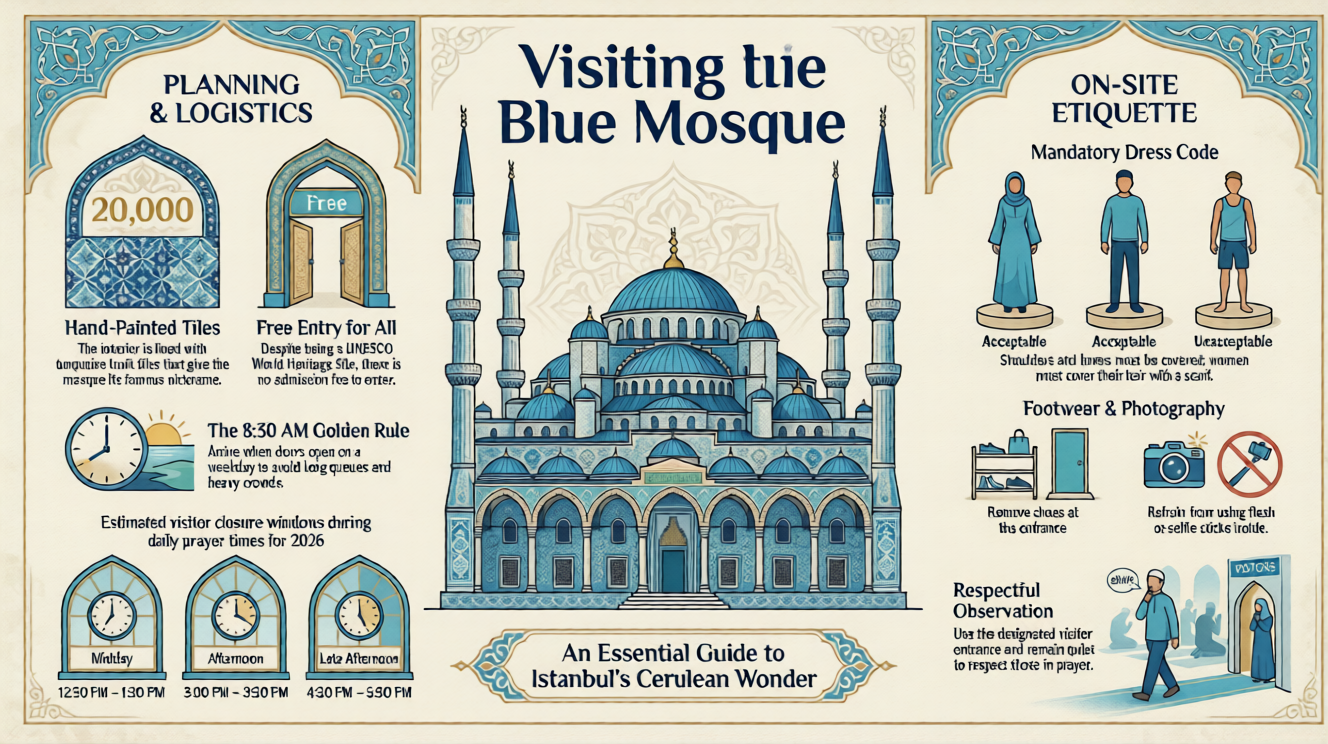
Formally known as the Sultan Ahmed Mosque (named after Sultan Ahmed I, who commissioned it in the early 1600s), the Blue Mosque gets its nickname from the roughly 20,000 hand-painted Iznik tiles that line the interior — all in shades of blue and turquoise that honestly look unreal under the dome lighting. The blue mosque Istanbul locals know so intimately has been a working place of worship since 1616. Think about that for a second. Over four hundred years of daily prayers within those walls.
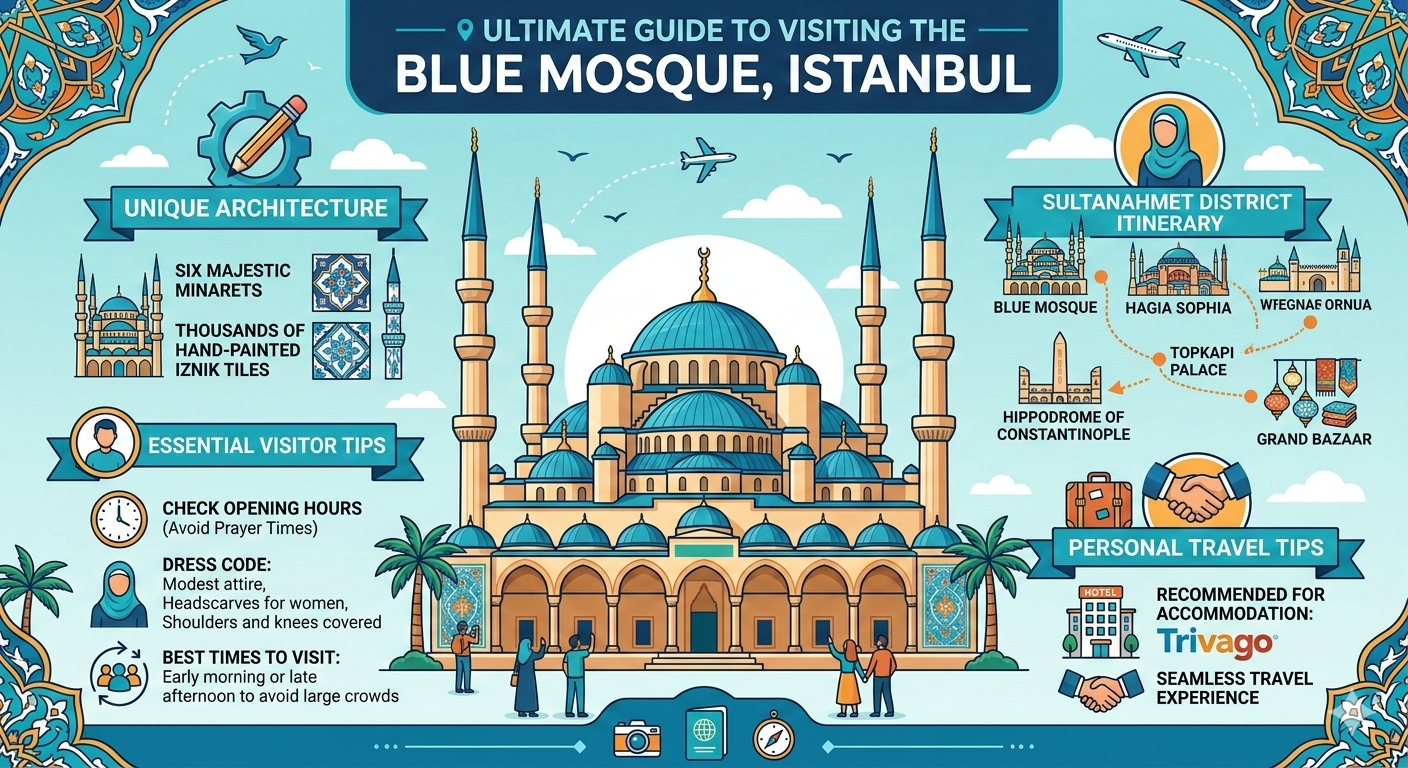
It sits in the Sultanahmet neighborhood, which is basically ground zero for everything iconic in Istanbul. You've got the Hagia Sophia grand bazaar Blue Mosque triangle — all within comfortable walking distance of each other. Some mornings I'd step out of my hotel, grab a simit (those sesame-crusted bread rings, absolute perfection with tea), and within ten minutes be standing in front of three UNESCO World Heritage Sites. Not bad for a Tuesday.
Blue Mosque Location — How To Actually Get There Without the Faff
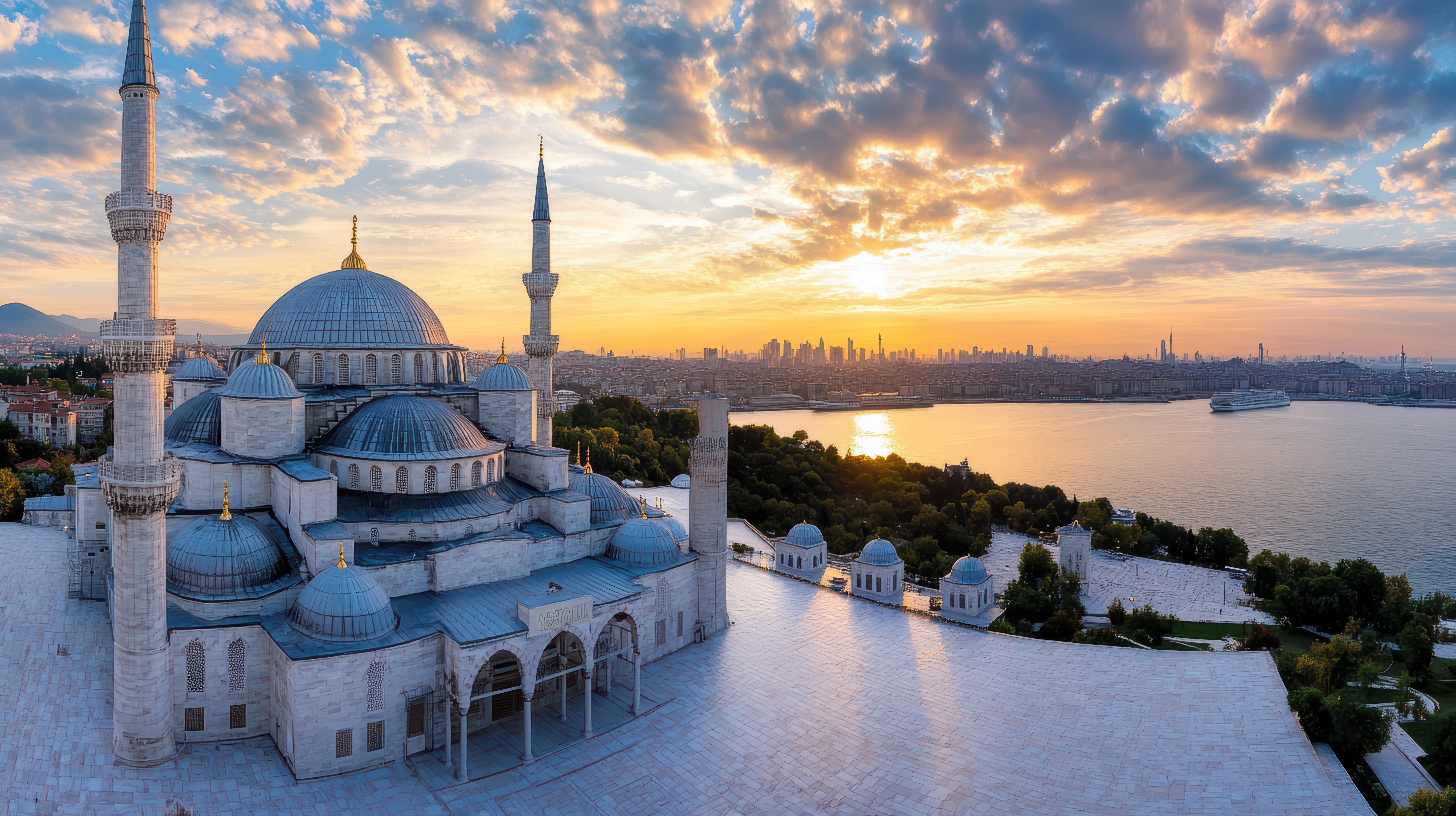
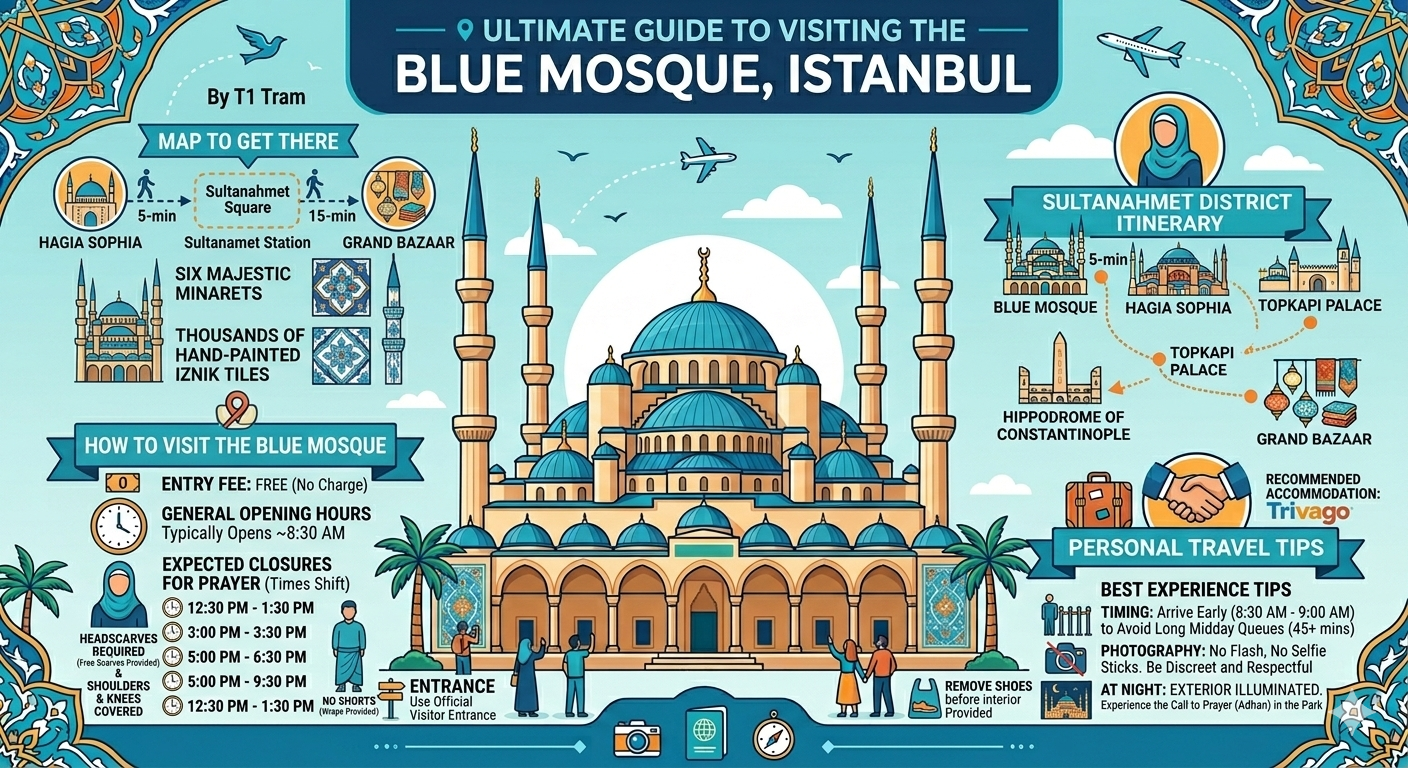
The location of Blue Mosque in Turkey — more specifically, Istanbul — is at Sultanahmet Square, Fatih district. Here's where the blue mosque location really rewards you: it's extraordinarily easy to reach.
By tram: The T1 tram line stops right at Sultanahmet station. From Eminönü or Kabataş, it's a clean, simple ride. The tram in Istanbul is genuinely underrated — cheap, frequent, and it drops you almost at the mosque's doorstep.
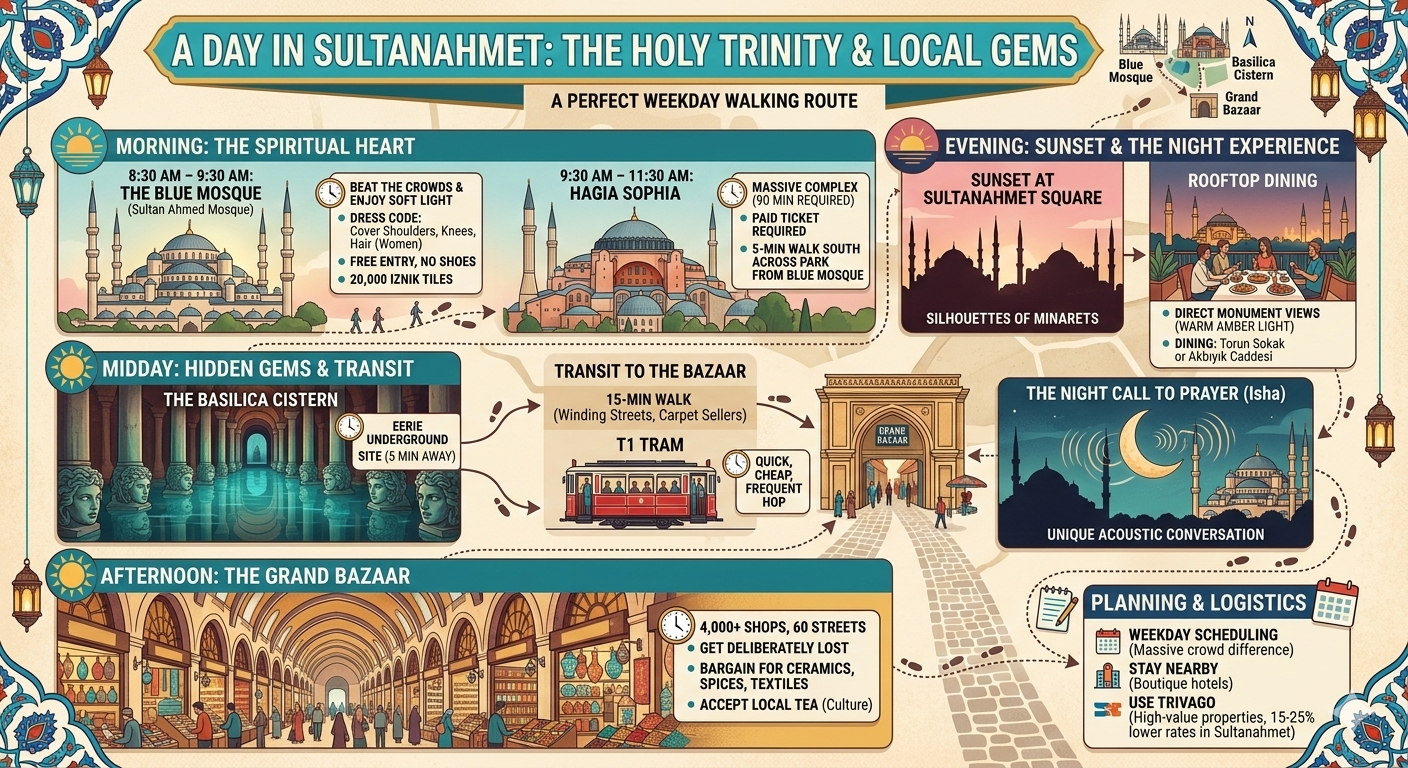
By foot from Hagia Sophia: Literally five minutes. Walk south across the park. Done.
From the Grand Bazaar: About fifteen minutes on foot, or a quick tram hop. I walked it both ways on different days — through the winding streets, past the carpet sellers and spice stalls — and honestly the walk is half the experience.
One thing nobody tells you? The park between the Blue Mosque and Hagia Sophia — Sultanahmet Square — is beautiful at both sunrise and sunset. I sat there at 6am one morning with a cup of Turkish tea from a nearby vendor. Just me, a few pigeons, and the silhouettes of minarets against a pink sky. No tour groups. No crowds. Just stillness. Go early if you can. Please, just go early.
Blue Mosque Opening Hours 2026 — What You Need To Know Before You Go
This is where a lot of travelers get tripped up. And honestly, I get it — I almost did too.
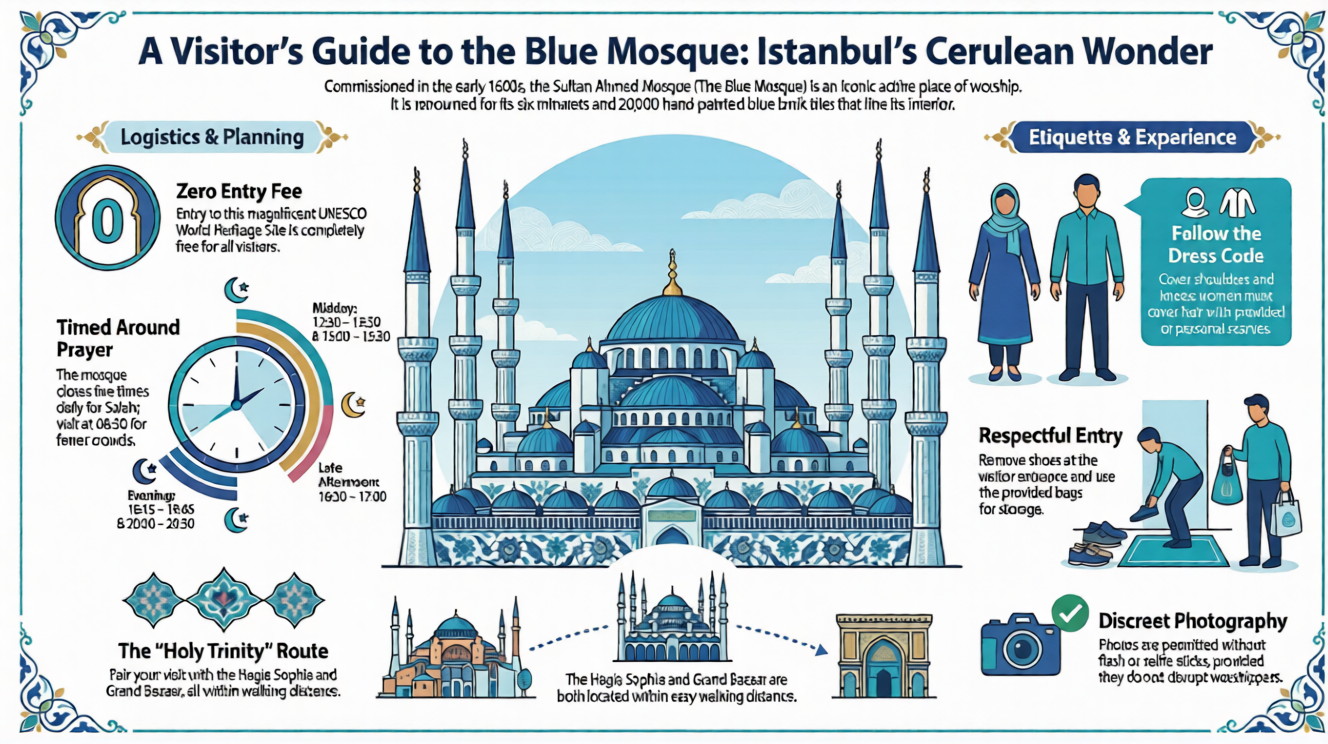
The blue mosque opening hours 2026 are a bit different from a typical tourist attraction because, remember, this is an active mosque. It closes to visitors during the five daily prayer times (Salah). Here's roughly what to expect for visiting the Blue Mosque:
- Opens to visitors: Around 8:30 AM
- Closes during prayer times: Approximately 12:30–1:30 PM, 3:00–3:30 PM, 4:30–5:00 PM, 6:15–6:45 PM, and 8:00–8:30 PM (times shift with season — always double-check)
- Last visitor entry: Around 30 minutes before closing
The exact blue mosque Istanbul visiting hours can shift slightly depending on prayer times, which change throughout the year. So my advice? Check the current times the day before or morning of your visit. Don't just assume.
Also — there's no entry fee. Free. Nothing. Nada. For one of the most magnificent structures on the planet. I still can't quite believe it.
How To Visit Blue Mosque — The Practical Stuff Nobody Puts in Travel Guides
Okay. This is the real section. The "I wish someone had told me this before I went" section.
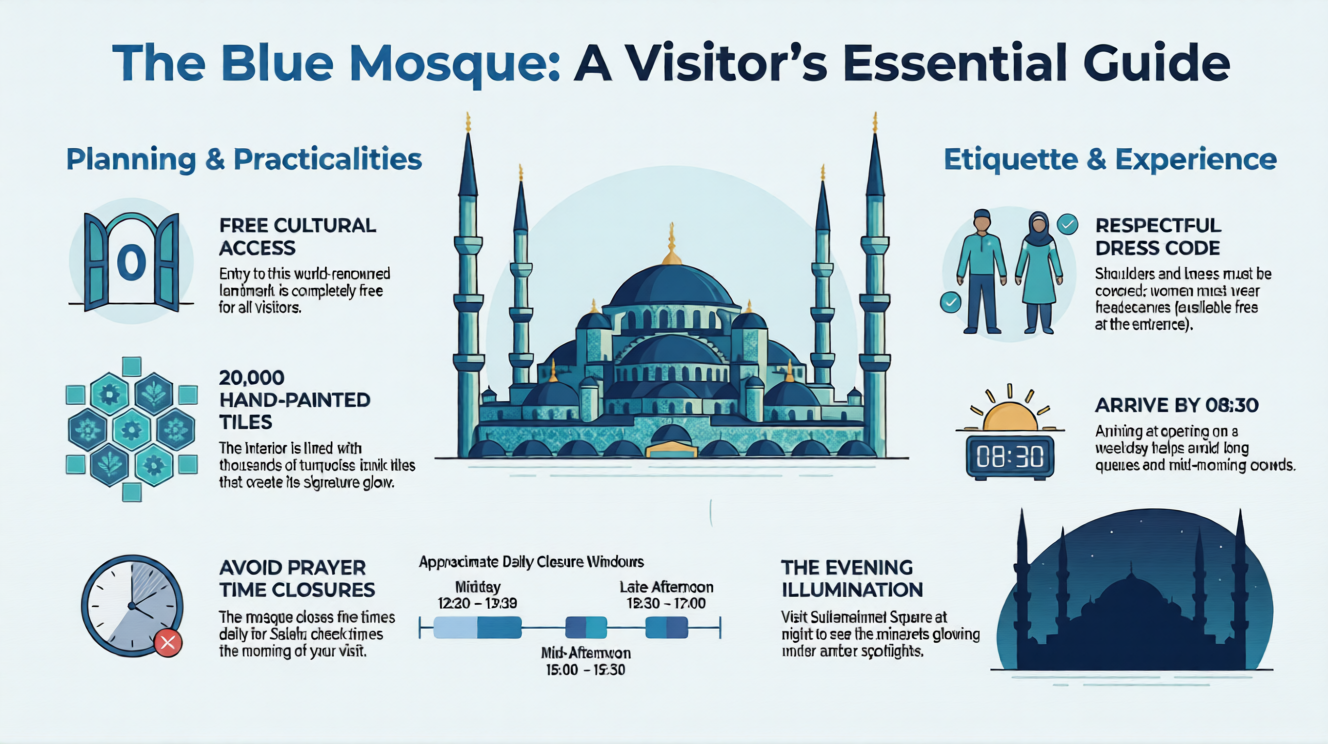
Dress code. This one matters. Shoulders covered. Knees covered. Women need to cover their hair — scarves are available for free at the entrance if you don't have one. I'd recommend bringing your own just to feel more comfortable. Men in shorts will need to wear a wrap — it's provided. Just be respectful about it. You're entering a sacred space.
The queue. There's an official visitor entrance (separate from the main worshipper entrance). The line can get long by mid-morning. I arrived at 9am on a Thursday and waited maybe 12 minutes. My friend went on a Saturday at 11am and waited nearly 45. Weekday mornings are your friend.
Shoes off. You'll remove your shoes before entering. Bring a bag or use the plastic bags provided. The floor is carpeted — soft, thick, and worn smooth by millions of feet before yours.
Inside the mosque. The interior is — I'm going to struggle to describe this properly. The dome is enormous. The Iznik tiles cover almost every surface in the upper galleries. Natural light pours through 260 windows. There's a low hum sometimes, or complete silence, or the distant echo of prayers. Stand still. Just stand still for a minute and take it in before reaching for your phone.
Photography is allowed inside — but be discreet. No flash. No selfie sticks. And please, please don't treat it like a photo set. There are people praying there. Real people. Be a visitor, not a tourist.
Blue Mosque at Night — The Experience Most Visitors Miss
Can I tell you about the blue mosque at night? Because this might be the most underrated travel experience in all of Istanbul, and almost nobody talks about it properly.
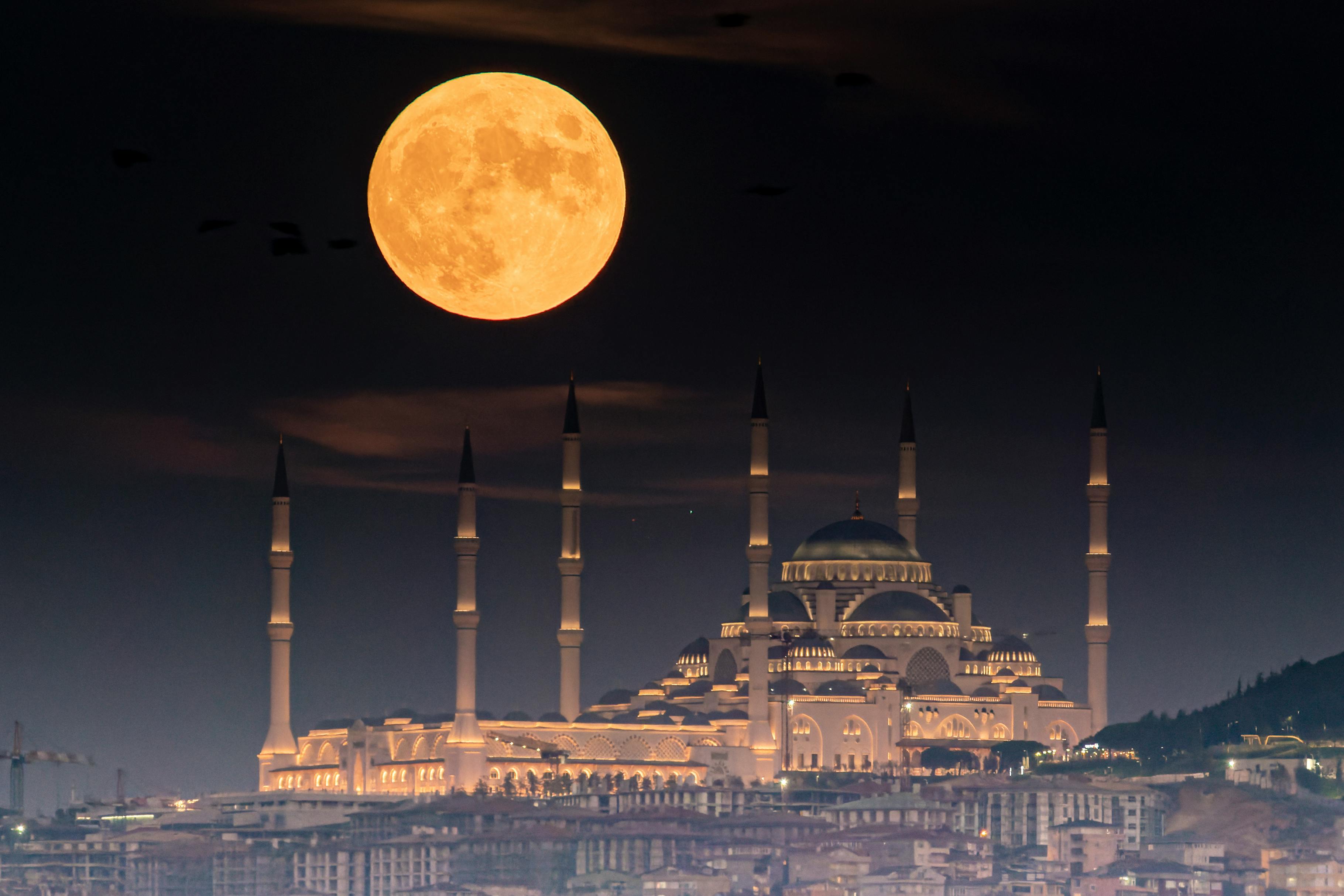
The mosque is illuminated after dark — a warm amber and white light that makes the stone glow and the minarets look almost liquid against the night sky. The surrounding park quiets down. Families walk through. Couples sit on benches. Tea sellers linger. The call to prayer echoes across Sultanahmet at Isha (the night prayer) and it bounces between the mosque and Hagia Sophia in this extraordinary acoustic conversation between two ancient buildings.
I sat there on a warm September evening for almost two hours. Just watching. A man next to me had a backgammon board. There was a child chasing pigeons. The city hummed distantly. And above it all, those six minarets pierced a sky full of stars.
You can't enter the mosque after hours unless you're attending prayer. But you don't need to be inside. Being in front of the blue mosque at night is its own kind of wonder.
Hagia Sophia, Grand Bazaar & Blue Mosque — Planning Your Sultanahmet Day
Since you're there — and you absolutely should be — let's talk about structuring your day around the holy trinity: Hagia Sophia grand bazaar Blue Mosque.
Morning: Hit the Blue Mosque first, around 8:30–9am. You'll beat the main crowds and the light inside is softer. Give it 45 minutes to an hour. This is truly the best time for visiting the Blue Mosque.
Then: Cross the park to Hagia Sophia. Allow at least 90 minutes — it's massive, complex, and worth slowing down for. Note that Hagia Sophia now requires a ticket (unlike the Blue Mosque), so check current pricing.
Afternoon: Walk 15 minutes (or tram) to the Grand Bazaar. One of the oldest and largest covered markets in the world — over 4,000 shops across 60 streets. Get deliberately lost. It's the only correct way to experience it. Bargain for ceramics, spices, lamps, textiles. Drink tea that vendors offer you freely.
Evening: Return to Sultanahmet for sunset and the blue mosque at night experience. Find a rooftop restaurant nearby with direct views of both the mosque and Hagia Sophia — watch the minarets light up over dinner. There are a few good ones along Torun Sokak and Akbıyık Caddesi.
That's a full day. That's one of the best days you can have anywhere in the world.
How I Found and Booked My Istanbul Trip — And Why Trivago Made It Effortless
Now, I get asked constantly: how do you actually plan a trip like this without overpaying or spending hours comparing hotel prices across fifteen different websites?
Trivago became my answer to that question — and I don't say that lightly. I've tried most of the major travel platforms over the years, and what Trivago does differently is pull hotel prices from hundreds of booking sites simultaneously. So you see a genuinely comprehensive comparison in one clean place, rather than hopping between sites and hoping you caught the best rate.
When I was planning my Istanbul stay, I used Trivago to find a hotel in the Sultanahmet area within walking distance of where is the blue mosque. I found a beautifully rated boutique property at a price that was frankly shocking given the location and quality. The search interface is clean, the filters are intuitive, and the reviews are detailed and clearly genuine. No fluff. No clutter. Just honest, searchable data that lets you decide confidently.
I've since used Trivago for trips to Lisbon, Kyoto, Marrakech, and Copenhagen — and it consistently saves me money while connecting me with properties I genuinely wouldn't have found otherwise. The customer experience is seamless from search to booking. Service quality is reflected in how clearly each hotel's information is presented — star ratings, guest reviews, cancellation policies, all visible upfront. Value for money is where Trivago really shines: I consistently find rates 15–25% lower than booking directly or through other platforms. It's comfortable to use, safe to trust, and overall satisfaction from my end? Genuinely excellent. If you're planning how to visit Blue Mosque and want a Sultanahmet stay without the financial anxiety — start with Trivago.

A Few Final Tips For Visiting the Blue Mosque
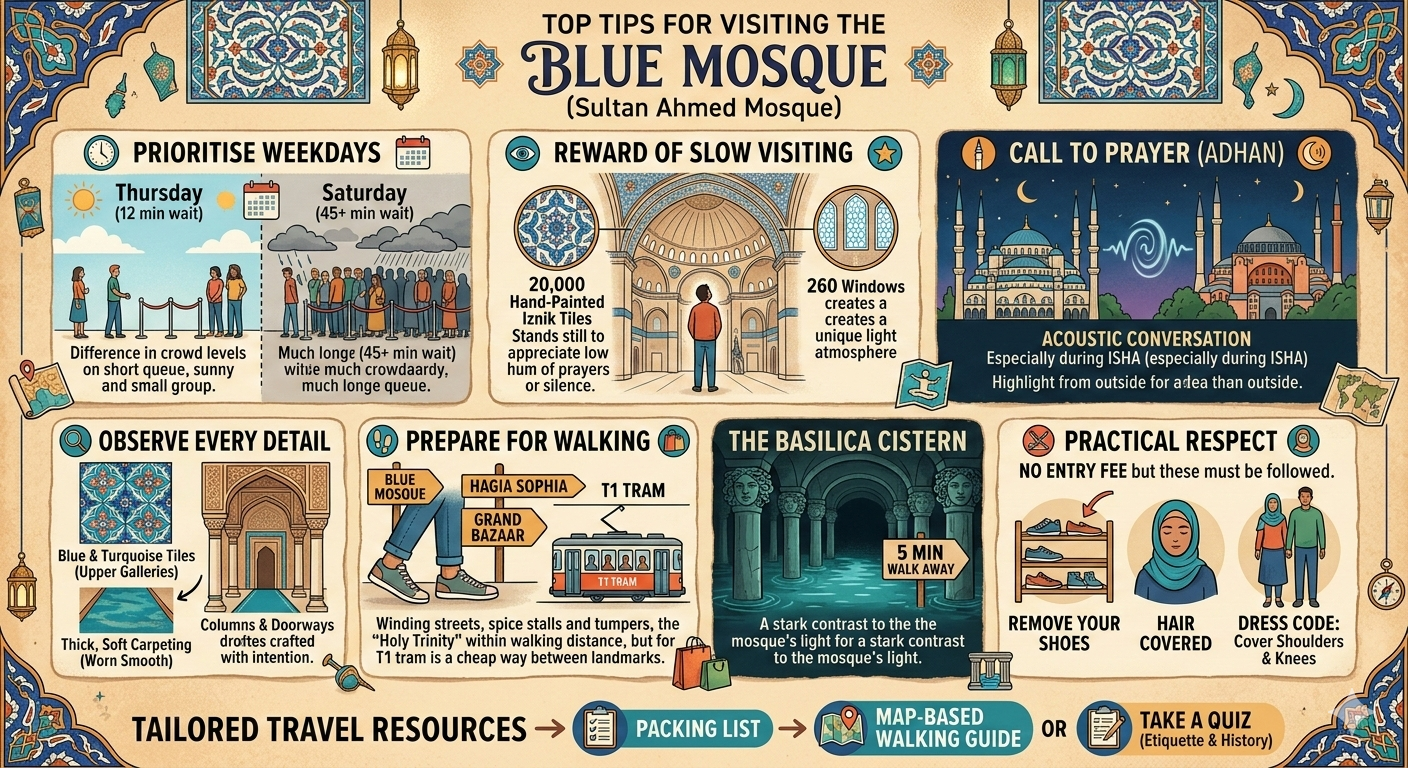
- Go on a weekday if your schedule allows. The difference in crowd levels is massive.
- Allow more time than you think you need. The interior rewards slow visitors.
- Hear the call to prayer. Even from outside, the Adhan echoing across Sultanahmet is unforgettable.
- Don't only look up. The floors, the columns, the doorways — every inch has been crafted with intention.
- Bring water and comfortable shoes. You'll walk more than you expect in this neighborhood.
- Combine with the Basilica Cistern — an underground Byzantine water reservoir just a five-minute walk away. Eerie, beautiful, and almost always overlooked.
Final Thoughts — How To Visit Blue Mosque and Actually Feel It
The best travel isn't about ticking boxes. It's about the moments that catch you off guard — the ones that make you stop walking, or go quiet, or just breathe differently for a second.
Knowing how to visit Blue Mosque properly — the right time, the right entrance, the right dress, the right attitude — it changes the experience entirely. You go from tourist to traveler. From observer to participant.
The blue mosque Istanbul is one of those places that doesn't care how many countries you've visited or how seasoned you think you are. It will humble you. Quietly, beautifully, and completely.
Plan your visit. Use Trivago to lock in a great hotel nearby so you can walk over at dawn. Stand in front of those six minarets. Let yourself be small for a moment.
It's worth it. It's so, so worth it.