
 Jun 19,2026
 By:
By: Introduction
🚍 Ride RomeSo you have finally booked your trip to Rome. The flights are sorted, the hotel is confirmed, and your list of things to see is already three pages long. But somewhere between landing at Fiumicino and actually standing in front of the Colosseum, there is a practical question that catches most tourists off guard: how do you actually get around this city without spending a fortune on taxis or getting completely lost?
The answer that most seasoned Rome visitors will give you is simple: learn how the bus works. And more importantly, sort out your bus tickets Rome style before you need them, not while you are standing at a stop with a bus pulling away. And if you are planning to travel beyond Rome to other Italian cities or even across Europe, FlixBus is the name worth knowing from the moment you start planning.
This guide covers everything, from where to buy tickets and how to use them, to which routes make sense for sightseers and what to know before you ever step on board.
Best Time to Visit Italy If You Want to Enjoy the Bus Without the Chaos
Before getting into ticket logistics, it is worth knowing when you are going. The best time to visit Italy, especially Rome, is either spring or early autumn. April through June gives you warm weather, longer daylight hours, and the city feels alive without being completely overwhelmed. September and October are equally good, with the summer heat fading and locals returning from their August holidays.If you visit in July or August, Rome can get brutally hot, and buses near tourist areas get packed by midmorning. Travelling early, before nine in the morning, makes a real difference. Buses are cooler, less crowded, and the streets themselves feel calmer.
Winter visits are perfectly manageable too. The city is quieter, Christmas markets pop up around the centre, and you will often find the major sights far less crowded. Buses run on their normal schedule year-round, so you are not losing any transport options by visiting in the cooler months.
Things to Do in Italy That Start and End at a Bus Stop
One of the underrated pleasures of using Rome's buses is that it puts you into the rhythm of the city in a way that taxis never quite do. You share space with people going to work, students heading to university, older residents doing their shopping. The things to do in Italy that stay with you longest are often not the big ticket attractions but the moments of ordinary life you stumble into between them.That said, the buses do take you directly to the big ticket attractions too. The Colosseum and Roman Forum are served by multiple lines. The Borghese Gallery, which sits inside a large park in the north of the city, is reachable by bus without any complicated transfers. The Campo de' Fiori and the area around the Pantheon are a short walk from several major stops.
Beyond the city itself, if you want to reach other parts of Italy from Rome, FlixBus operates routes connecting Rome to destinations like Naples, Florence, Milan, and many others. Tickets are affordable, buses are modern and comfortable, and booking takes just a few minutes through the FlixBus website or app. It is one of the most straightforward ways to extend your Italian adventure beyond the capital without the stress of car hire or expensive train fares.
Why Bus Tickets Rome Travellers Use Are Worth Understanding First
Here is something that surprises a lot of first-time visitors. Rome does not have a massive metro system the way London or Paris does. The underground only covers two lines, and those lines skip over huge chunks of the city, including most of the places tourists actually want to visit. The Trevi Fountain, the Pantheon, Trastevere, Campo de' Fiori — none of these are on the metro.That is where the bus becomes your best friend.
Buses run all over the city, including through the narrow streets of the historic centre where no train could ever go. They pass by old churches, open piazzas, and the kind of everyday Roman street life that you cannot see from underground. For comfortable travel options that also happen to give you a moving view of the city, the bus genuinely delivers in a way that other transport simply cannot.
And practically speaking, the same ticket that gets you on a bus also works on trams and gives you one metro journey, so you are not buying multiple passes for different modes of transport.
How to Buy Bus Tickets in Rome Without the Stress
This is the part of Rome's transport system that causes the most confusion, and honestly, it should not. Once you know the routine, it is completely straightforward.The most important thing to understand about how to buy bus tickets in Rome is that you cannot pay on the bus itself. There is no cash machine on board, no driver selling tickets, nothing like that. You need a valid ticket before you get on, which means sorting this out in advance becomes part of the plan.
Tabaccherie are your most reliable option. These are the small tobacco and news shops you will spot all over Rome, marked by a black T sign on a yellow background. They open early, close late, and almost all of them sell bus tickets. The staff are used to tourists asking, so do not worry about language barriers. Just say "un biglietto" for one ticket, or hold up fingers if it is easier.
Newsstands near busy stops and squares also sell tickets regularly. If you are near a major piazza or a well-trafficked street, have a look around and you will usually spot one within a short walk.
Ticket machines at metro stations are a solid backup option, especially if you arrive late when shops are closed. They take both cash and cards, and you can switch the language to English. They are not always perfectly maintained, so if one does not work, find another.
The ATAC app is genuinely useful for travellers who prefer having everything on their phone. You can buy tickets digitally, store them, and use them directly without needing a paper ticket at all. Download it before you leave home and you are sorted before you even land.
Termini Station is the main transport hub and has multiple points of sale for bus tickets, including staffed counters where you can ask questions if you need help. And if you are heading out of Rome on a longer journey, this is also where you will find FlixBus connections to other Italian cities and destinations across Europe, with tickets available directly through the FlixBus website or app.
Where to Buy Bus Tickets in Rome: A Practical Summary
When you are trying to figure out where to buy bus tickets in Rome quickly, here is what to look for:The black T sign marks any tabaccheria, and these are genuinely everywhere. Newsstands near piazzas almost always carry tickets. Automated machines sit inside or just outside every metro entrance. Termini has counters, machines, and kiosks all in one place. The ATAC app works from anywhere with a connection. Some supermarkets in central areas also stock them at the checkout, which is easy to overlook but handy when everything else is closed.
Buying a handful of tickets at once is always a smart move. You never know when you will need one and find yourself nowhere near a shop.
The Ticket Types and What Each One Actually Covers
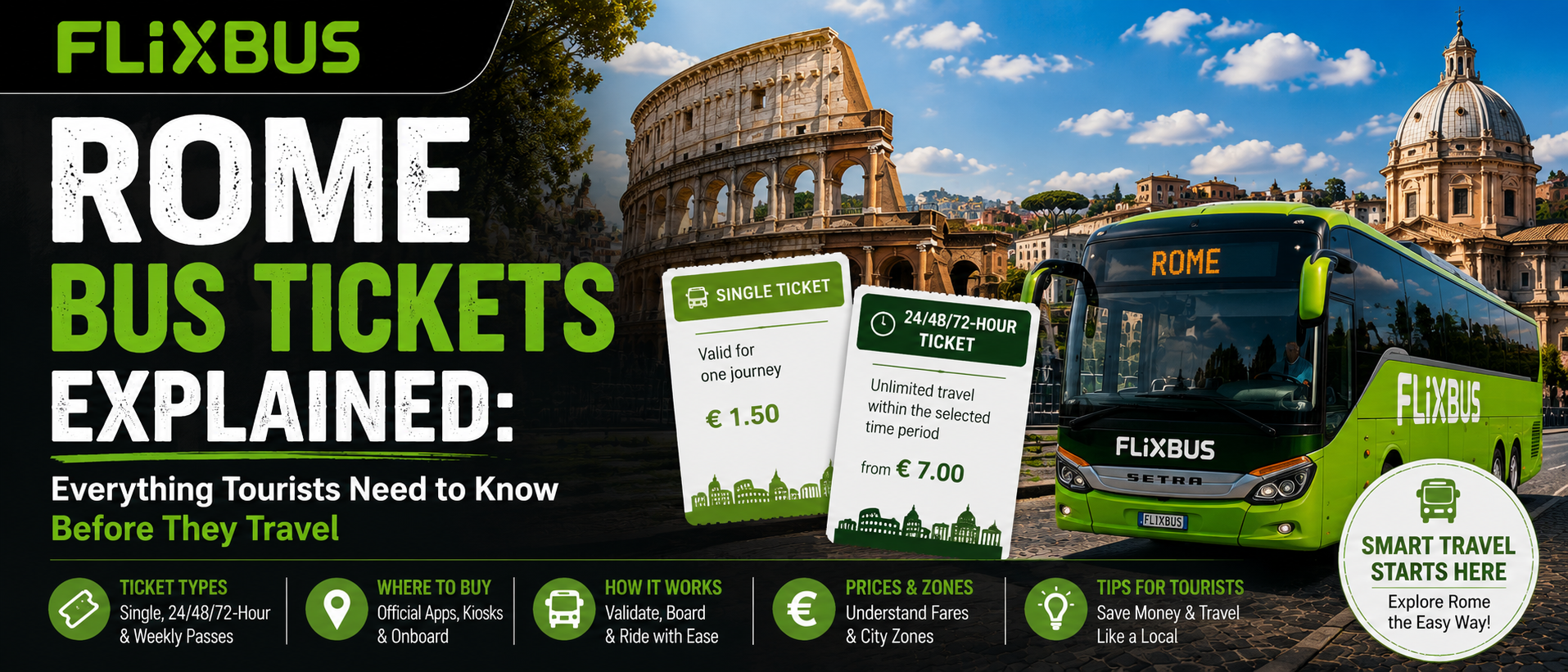
Rome's ticketing structure is more flexible than people expect, with options that suit everything from a single quick journey to a full week of exploring.The single journey ticket, known locally as the BIT, gives you 100 minutes of travel from the moment you validate it. Within that window, you can hop between buses and trams as many times as you like, plus take one metro ride. For a short trip across the city, this is perfectly adequate.
The 24-hour pass is worth it on any day when you know you will be moving around a lot. It starts from your first validation and gives you unlimited travel until the end of that window. On a packed sightseeing day, it pays for itself quickly.
The 48-hour and 72-hour tickets follow the same logic. If you are spending two or three days covering the city's main sights, these passes remove the mental arithmetic of whether each individual journey is worth it. You simply get on and go.
The weekly pass, the CIS, covers seven days from first use. If Rome is your main base for a longer trip and you plan to use public transport daily, this is the most economical choice by a clear margin.
One thing every visitor must do regardless of which ticket they buy: validate it. There is an orange machine on board every bus. Press your ticket against it when you board. The machine stamps the time, and from that moment your window starts. Failing to validate is treated as travelling without a ticket, even if you bought it legitimately, and inspectors do check.
Finding the Best Bus Route for What You Want to See
Rome's bus map looks complicated at first glance, but finding the best bus route for any given journey is much easier than it appears once you know how to approach it.The ATAC journey planner on their website and within the app lets you put in a starting point and a destination and get back a route with times, stops, and any required changes. Google Maps also pulls in live ATAC data, so real-time tracking works directly from your phone without needing a separate app.
Some routes come up frequently for tourists. The 40 and 64 run between Termini and the Vatican area, passing through the historic centre. They are useful but can get very crowded near the main stops. Bus 23 follows the Tiber River and is one of the nicest rides in the city, going through the Trastevere neighbourhood and past parts of the riverbank that feel genuinely local. The H line runs along a long north-south axis and is helpful for moving between different zones quickly.
For anyone heading out to the further neighbourhoods or trying to reach a less central attraction, the ATAC planner will usually suggest a combination of one or two buses with a short walk at the end. That combination of bus and walking is honestly how most Romans get around too.
Alternative Travel Options Worth Knowing About
While buses cover the bulk of Rome's surface transport, knowing your alternative travel options helps when the bus is not the fastest or most convenient choice.Trams run on several lines through different parts of the city and share the same ticketing system. If a tram route covers where you are going, it is often a smoother and quieter ride than a crowded bus.
Walking deserves more credit than it usually gets in Rome. The historic centre is remarkably compact. The distance from the Pantheon to Piazza Navona is about five minutes on foot. The Colosseum to the Roman Forum entrance is a few hundred metres. Many tourists who plan to take the bus for every journey discover that their feet get them there just as fast, with a lot more to see along the way.
Electric scooters and docked bike rental schemes are available across the city for those comfortable cycling in urban traffic. They work well for shorter hops and are particularly pleasant along the riverbanks where traffic thins out.
For longer journeys out of the city, FlixBus stands out as one of the most comfortable travel options available to tourists in Italy. With free Wi-Fi on board, generous legroom, power sockets at every seat, and the ability to bring luggage without extra hassle, it makes intercity travel genuinely relaxing rather than something to endure. Routes depart from Termini and connect Rome to hundreds of destinations across Italy and beyond, all at prices that leave more budget for the gelato and the galleries.
Practical Tips That Make the Bus Experience Much Smoother
A few habits separate the tourists who find Rome's buses easy from those who find them baffling.Validate the moment you step on board. Not when you find a seat, not once you have checked your phone. The machine is usually near the door and it takes two seconds.
Board at the front or rear doors, not the middle. The middle doors are for exiting. Following this unspoken rule keeps the flow moving and marks you out as someone who knows what they are doing.
Keep your ticket on you until you are fully off the bus and walking away. Inspectors do random checks and they board at any stop without warning. Getting caught without a validated ticket leads to a fine that dwarfs the cost of any pass.
Check the destination board at the front of the bus before boarding. Routes sometimes run in shorter versions during off-peak hours, which means the bus might terminate before your stop.
Watch your belongings on crowded buses, particularly near the main tourist stops. Keep bags in front of you and stay aware of your surroundings, especially on the busiest routes through the centre.
The Best Places to Visit in Italy Start with Getting Around Right
Rome rewards people who move around it confidently. The best places to visit in Italy include this city for a very good reason, but the experience of being here changes depending on how you navigate it. Tourists who spend half their day hailing taxis or waiting for ride-hailing apps see a different city than those who learn the bus routes, buy their tickets in advance, and move through the neighbourhoods with some independence.The bus puts you at street level, moving through real Roman life, with the same view the locals have. That is genuinely valuable.
And when you are ready to push further, when Rome has given you everything it has and you want to see Pompeii, the Amalfi Coast, or the rolling hills of Tuscany, FlixBus makes that next chapter easy. Affordable tickets, a simple booking process, comfortable seats, and a network that stretches across more than 40 countries mean the rest of Italy, and Europe, is never far away.
Everything About Bus Tickets Rome Visitors Should Carry With Them
When you land in Rome, the simplest version of this advice is: buy a handful of bus tickets Rome visitors actually use on your first day, validate every single one when you board, and download the ATAC app so you always know when the next bus is coming. If day trips or longer journeys are on your itinerary, sort your FlixBus tickets in advance too — it takes five minutes online and takes a significant item off your planning list.Beyond the logistics, the bus is one of the most human ways to experience a city that has been carrying people through its streets for more than two thousand years. The routes change, the vehicles get newer, but the experience of moving through Rome at ground level, watching the city pass by your window, is something worth having.
Sort your tickets, learn a couple of routes, and then just go. Rome does the rest.
🚍 Ride Rome
Experience the world with Travelnags. Your trusted travel companion - guides, budget advice, destination tips and good deals to help you travel smarter, cheaper and better, together!