
 Jun 16,2026
 By:
By: Introduction
⚽ Match PredictionsSo the FIFA World Cup 2026 is finally here. Not "coming soon," not "next summer"—here, right now, balls are already rolling across stadiums in three countries. And honestly? It still feels a little surreal to type that sentence. We spent years talking about an expanded 48-team format like it was some distant hypothetical, and now Mexico has already beaten South Africa 2-0 in the opener, groups are mid-swing, and half of Group C is arguing about goal difference on social media.
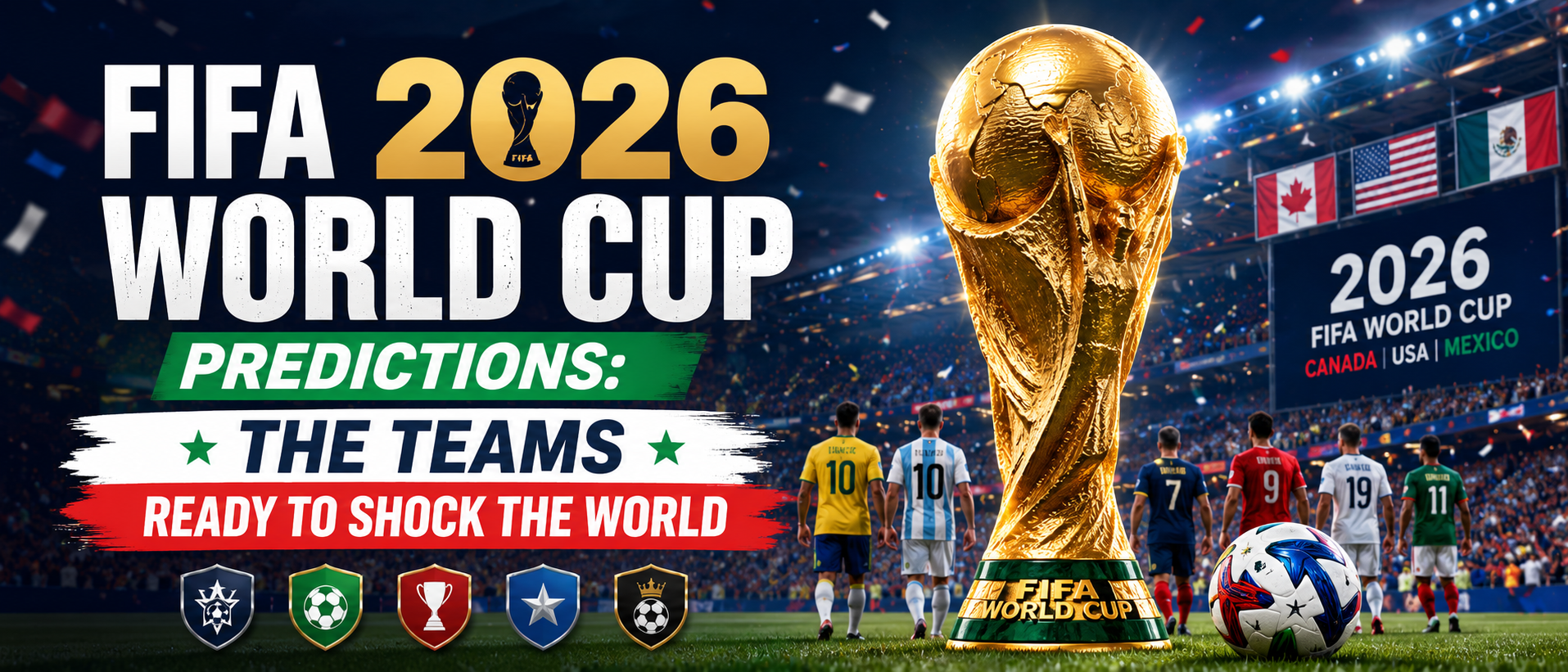
This piece isn't another "here's everything you already know" rundown. It's about the teams nobody's circling on their bracket—until they win. Every World Cup produces at least one team that crashes the party uninvited. Senegal in 2002. Costa Rica in 2014. Morocco, famously, in 2022. This time, with 48 teams instead of 32, the odds of a genuine shock go up. A lot.
What Is the FIFA World Cup, Anyway?
Quick detour, because some readers landing here are new to all this (no judgment—soccer fandom sneaks up on people). What is the FIFA World Cup? It's the men's international football tournament run by FIFA, held every four years, where national teams—not clubs, national teams—compete for the sport's biggest trophy. It is, by most measures, the single most-watched sporting event on the planet. The 2022 final alone pulled in over a billion viewers. Try wrapping your head around that number. I can't, not really.The 2026 edition is the 23rd. It's co-hosted by the United States, Canada, and Mexico—the first time three countries have shared hosting duties—and it's the first ever to feature 48 teams instead of 32. That's 104 matches total. A genuinely massive undertaking.
The FIFA World Cup Draw: How We Got Here
The FIFA World Cup draw happened back in December 2025, splitting the 48 qualified nations into twelve groups of four. Group A through Group L. Some groups landed soft (relatively speaking—nothing's "soft" at this level), others turned into immediate nightmares. Argentina, defending champions with Messi likely playing his final World Cup, got drawn into Group J alongside Algeria, Austria, and World Cup debutants Jordan. France ended up with Senegal, Iraq, and Norway in Group I—a group that's tougher than it looks on paper, mostly because of Norway.And speaking of debutants—this is actually one of the most interesting storylines of the whole tournament. Four nations are playing their first-ever World Cup match this summer: Cape Verde, Curaçao, Jordan, and Uzbekistan. That's the most debutants since Germany 2006, when Ghana and Ukraine both turned heads. Curaçao, a Caribbean island of roughly 150,000 people, somehow qualified and now finds itself staring down four-time champions Germany in Group E. Germany already put seven past them in a recent friendly. Brutal, sure. But just qualifying is the story for a nation that size.
Teams Ready to Shock the World
Okay. Here's the part you came for.Norway isn't really a sleeper anymore—not with Erling Haaland leading the line and Martin Ødegaard pulling strings in midfield—but they're returning to the World Cup stage after a long, frustrating absence, and that hunger matters. Drawn into Group I with France and Senegal, Norway has the individual talent to do real damage. If Haaland gets even half-decent service, defenders are in trouble.
Cabo Verde, the "Blue Sharks," sealed their spot on the final day of African qualifying with a win in front of a packed (if modest by global standards) 8,000-seat stadium back home. They're the third-smallest nation by population ever to qualify for a men's World Cup. Their head coach, Pedro "Bubista" Brito, has built this thing patiently since 2020—patchy pitches, limited funding, slow progress, the whole underdog cliché, except it's true this time. Don't be shocked if they nick a point or two off bigger names.
Then there's Jordan. Tucked into Group J with Argentina, Algeria, and Austria, Jordan's coach Jamal Sellami has openly invoked Morocco's 2022 semifinal run as inspiration. Jordan plays compact, disciplined, hard-to-break-down football—not flashy, not built to dominate possession, but exactly the kind of setup that frustrates bigger teams into mistakes. Four points from three games gets you through in this format. That's not nothing.
Scotland—back at a World Cup for the first time since 1998—landed in Group C with Brazil, Morocco, and Haiti. Eerily, it's almost the exact same group (minus one team) Scotland faced in '98. History repeating itself, sort of. Steve Clarke's side already opened with a result that had pundits sitting up straighter than expected.
And don't sleep in Saudi Arabia. Yes, this is the same federation that produced one of the greatest World Cup shocks ever—beating Argentina in 2022. Lightning doesn't usually strike twice. Usually.
Honestly, with 32 of the 48 teams advancing past the group stage this time (up from just 16 in the old 32-team format), the door for surprise runs is wider than it's ever been. Eight third-place finishers also sneak through. It's chaos, in the best way.
More Dark Horses Worth Watching
A few more names kept coming up while I was digging through group breakdowns, and I figured they deserved a mention before moving on.Uzbekistan—the other debutant nobody's really talking about yet. Built almost entirely through youth competition pipelines, with zero World Cup pedigree to lean on. No pressure of expectation, which sometimes turns into an advantage. South Korea pulled off something similar in 2002, hosting their way to a semifinal nobody saw coming. Uzbekistan isn't hosting anything, obviously, but the parallel—unknown quantity, tight-knit squad, nothing to lose—still applies.
Türkiye, landing in Group D alongside host nation USA, Australia, and Paraguay, might have the deepest young core of any so-called "dark horse" in the field. Arda Güler at Real Madrid, Kenan Yıldız at Juventus, Hakan Çalhanoğlu pulling strings for Inter Milan. Some analysts are calling this Türkiye's most talented generation since the 2002 semifinalists. If they top the group, the knockout draw opens up in interesting ways.
Haiti, making just their second World Cup appearance—their first since 1974—drew into Group C with Brazil, Morocco, and Scotland. Coincidentally (or not), Brazil, Morocco, and Scotland were drawn together once before, back in 1998. History has a strange sense of humor sometimes. Haiti's not expected to advance, but expectation and reality don't always line up, and that's sort of the whole point of this article.
And one more: Ecuador. Their high-altitude training base gives them a conditioning edge that's hard to replicate, and they've quietly built a habit of outlasting bigger names in the final twenty minutes of group-stage matches. Worth keeping an eye on, especially in close games that go the distance.
Host Nations: USA, Canada, and Mexico's Chances
Can't really talk about the FIFA World Cup 2026 without mentioning the hosts. Mexico opened the tournament with that 2-0 win over South Africa—solid, if not spectacular, and exactly the kind of start a host nation needs to settle the nerves of a soccer-mad country watching at home. The United States, in Group D with Australia, Paraguay, and Türkiye, has home-field advantage and a roster blending MLS talent with players pulling minutes at top European clubs. Canada, meanwhile, drew Bosnia and Herzegovina, Qatar, and Switzerland in Group B—tougher than people initially assumed, with Switzerland in particular looming as a quietly dangerous opponent.Host nations have a strange history at World Cups—sometimes they overperform on home energy alone (France '98, South Korea 2002), sometimes the pressure swallows them whole. With three hosts this time, that pressure gets split three different ways. Might work in their favor. Might not. We'll see.
FIFA World Cup Schedule: The Shape of the Tournament
The FIFA World Cup schedule breaks down like this:- Group stage: June 11 – June 27
- Round of 32 (a brand-new round, thanks to the expanded format): June 28 – July 3
- Round of 16: July 4 – July 7
- Quarterfinals, semifinals, and the third-place match follow
- The final: Sunday, July 19, 2026, at MetLife Stadium in East Rutherford, New Jersey—rebranded "New York New Jersey Stadium" for the tournament, since FIFA strips sponsor names from venues during the event. Kickoff is 3 p.m. ET.
That stadium alone hosts eight matches across the tournament, building toward that final. Roughly 80,000 fans are expected to pack in for it. Wild to think about.
Checking the FIFA World Cup Standings
If you're trying to follow the FIFA World Cup standings as games unfold, here's the system: each of the twelve groups plays a round-robin, three matches per team, with the top two automatically advancing to the Round of 32. The twist this year—the one that's already causing arguments online—is that eight of the twelve third-place teams also advance, ranked by points, then goal difference, then goals scored, then a "team conduct" score (yellow/red cards), and finally FIFA ranking if it's still tied after all that. Complicated? Extremely. Could it decide whether, say, Scotland gets through while Sweden doesn't? Also yes.FIFA's official site tracks live standings, and most major sports outlets mirror it in real time, so checking in daily isn't a bad habit if you're following multiple groups.
How to Get FIFA World Cup Tickets (And What They Cost)
People ask constantly: how to get FIFA World Cup tickets at this point in the tournament. The honest answer—most of the structured sales phases have already closed. The Visa Presale Draw ran back in September 2025, the Early Ticket Draw in October, and the Random Selection Draw over December and January. Those were lottery-based, not first-come-first-served.What's live right now is the Last-Minute Sales Phase, which opened April 1, 2026, and runs straight through to the final whistle on July 19. Unlike the earlier draws, this one's simple: create a free FIFA account at FIFA.com/tickets, browse what's available, and buy if you can grab it before someone else does. No lottery. Just speed.
As for FIFA World Cup tickets price—it varies wildly by category and demand, because FIFA uses dynamic pricing (prices move with demand, not fixed face value). Group stage tickets started around $60 for the cheapest tier. Final tickets are a different universe entirely—as of June 2026, official final tickets range from roughly $2,030 on the low end up past $32,000 for the top categories, plus a 15% service fee on top. There are four seating categories (Cat 1 through Cat 4), with Cat 1 being lower-bowl, closer-to-midfield seats, and Cat 4 sitting up in the corners.
One more thing worth knowing: FIFA is the only authorized primary seller. There's an official FIFA Resale/Exchange Marketplace too, for anyone reselling legitimately purchased tickets. Anything bought outside those two channels carries real risk—counterfeit tickets, cancelled accounts, the works. Stick to the official routes if you can.
Final Whistle
Predicting a 48-team World Cup is, frankly, a fool's errand if you're aiming for precision. Too many variables. Too many teams nobody's scouted properly. But that's exactly what makes the FIFA World Cup 2026 worth watching closely—not just the favorites everyone already expects to do well, but the Cabo Verdes and Jordans and Curaçaos of the tournament, the teams playing with absolutely nothing to lose. History says at least one of them breaks through. We just don't know which one yet. That's the fun part.⚽ Match Predictions
Experience the world with Travelnags. Your trusted travel companion - guides, budget advice, destination tips and good deals to help you travel smarter, cheaper and better, together!